

We’ve finally gotten a few days of respite from the excessive heat that has dominated our northern Ohio summer so far, and I’m grateful. It’s been cool enough to sleep with windows open at night and to use the whole-house fan to suck cooler air inside the house so I don’t have to use the A/C. It’s been very refreshing and rejuvenating. It’s hard to overstate the impact the heat has had on my life these past few months; it’s been years since I’ve spent so much time indoors in the summer. I’ve missed my bug friends.
For the entire month of July, I was worried because I wasn’t finding many of the insects I’ve come to expect in my garden. I thought it might have something to do with the heat — and it might — but it could be because I can only tolerate being outdoors for short periods of time. If I’m not out there looking as much, it stands to reason that I won’t find as many bugs. I’m still concerned about lower numbers and diversity this year though, and won’t breathe easy until I see a hoped-for rebound next summer. Maybe this is just a normal fluctuation in populations. Fingers crossed.
But my garden has been full of wonders these past few days. It started with a surprise and a slight disappointment. I’d been watching a couple of black swallowtail caterpillars on my fennel, and knew they were nearing their time to pupate into butterflies. Normally I can’t find them once they leave their host plant to find a spot to hang up and form a chrysalis, but I was really lucky this time and found one of them. Notice the silk girdle it spun to support itself during the process of changing into a butterfly.

I’ve been on a weeding binge lately, trying to pull the hundreds of rose of sharon babies that sprout up all over the yard, but I’m glad I hadn’t gotten to this one yet because it makes a great support for metamorphosis! I took a photo of the “prepupa” caterpillar on Thursday morning, and was surprised to find it hadn’t changed at all by noon on Friday. A quick bit of research told me that it can take a couple days for them to make a chrysalis when temperatures are cooler. I thought, “Okay, I can wait.”
So I went to run some errands Friday afternoon and guess what? The little sucker did it while I was at the grocery store! I came home to find this gorgeous green-and-yellow chrysalis already formed. Isn’t it amazing?
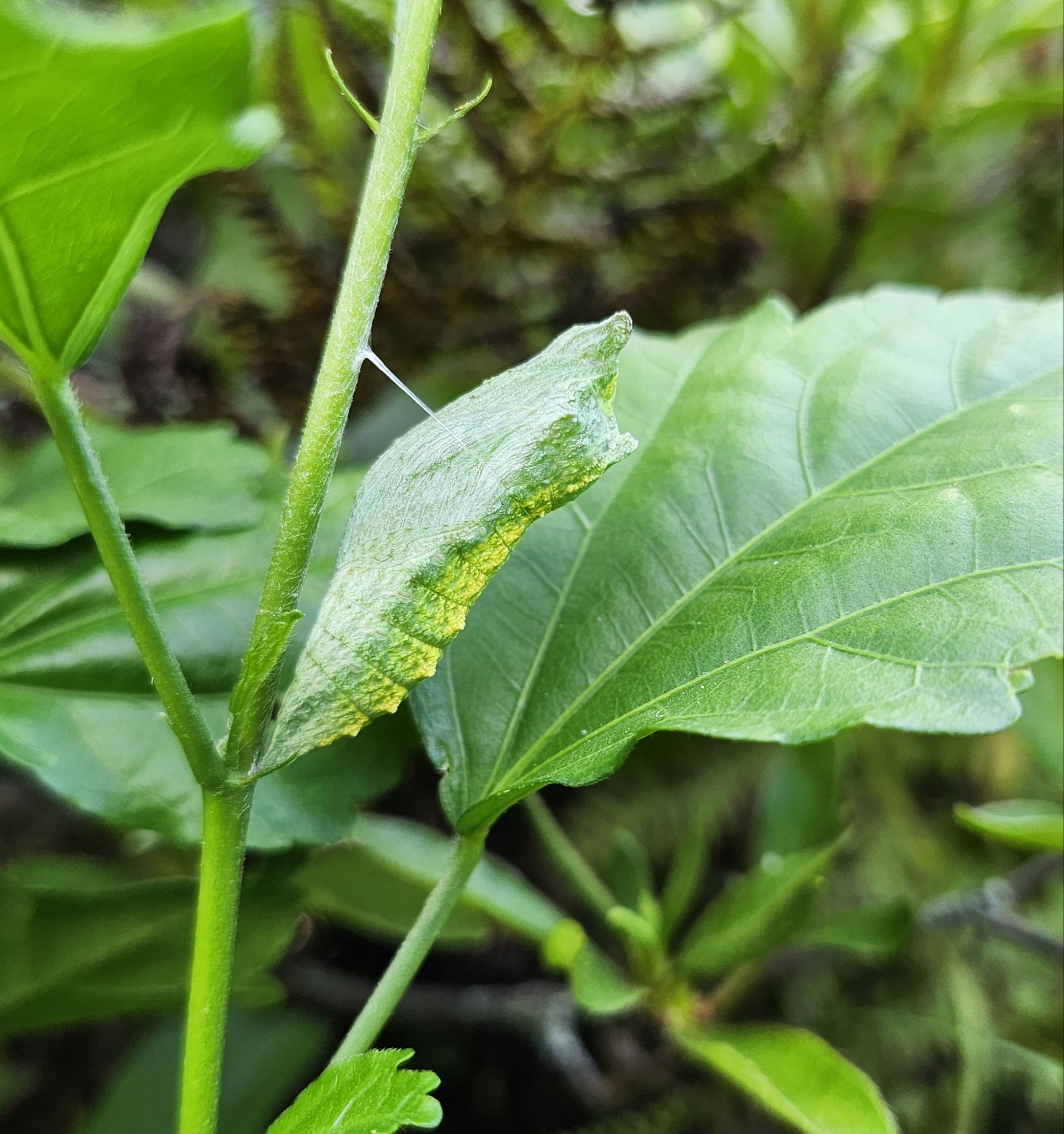
I’ve read that a green chrysalis means it will emerge this year, while a brown one would mean it was going to overwinter in this stage. It should take 9-18 days to emerge as a butterfly, assuming this isn’t the overwintering generation. So next weekend I’ll begin spending more time watching it, hoping to be there for the moment it emerges as a beautiful, fresh butterfly.
And while I’m on the subject of butterflies, I’ve also found a couple of monarch caterpillars, finally. I had been looking for them regularly on the milkweed, to no avail. And then suddenly I found two of the large last instar caterpillars, which means they’ve been here all this time in smaller instars but I just couldn’t find them. That always drives me nuts. Here you can see the caterpillar and the adult monarch that it will become in a couple weeks. (You can learn about the various monarch instar stages at Monarch Joint Venture, here.)


This beautiful tiger swallowtail spent at least 15 minutes feeding in my tiny patch of zinnias the other day. I’m glad I decided to grow zinnias for the first time, even though they’re not natives here. I believe it’s important to allow ourselves some latitude in efforts to plant native gardens; it doesn’t have to be 100% natives to make a difference for wildlife. For a few years I denied myself some cultivated plants that I’d loved before I learned about natives; I’ve been much happier since I planted some peonies here. I have fond childhood memories of them at my grandma’s house in West Virginia.

And I had an enchanting encounter with a little house wren family too. I often hear the chittering calls of the adult wrens in the garden, but on this day the calls were much more insistent and I could tell I was hearing at least two birds. As it turned out, there were two recently-fledged juveniles following their mama around the garden, shrieking orders at her to “Feed me, feed me!”
Take a listen to house wrens calling at this Audubon link. Scroll to the “excited chit calls” to hear what I heard in the garden.

The two youngsters were sitting atop the 6-ft tall fence while she was in the garden below, finding food for them. At one point they both spread their wings out and laid down to sunbathe as they waited for her. But they continued their calls for food. This picture isn’t a great shot, but I wanted to show you how both of the babies did the same behavior at the same time. It was adorable.


The more time I spend in my garden, the more fascinating wildlife behavior I get to see. I share this small plot of land with lots of animals of many sizes, from five-foot-tall white-tailed deer to the tiniest little leafhoppers. Mammals, birds, amphibians, insects, and spiders — we’re all fellow citizens of this amazing planet, just making our way the best we can. I’m so grateful that I finally tuned in to the non-human natural world after decades of not noticing it at all. My gosh, the amazing things I must have missed!!
 Nature is my Therapy
Lovely photos, thank you for sharing. I like your garden!
LikeLiked by 1 person
Thank you, Kate, and thanks for subscribing!
LikeLike
Hi Kim-I am bug nerd like you and I have a native plant garden on Vancouver Island. We have recently had a hot stretch and I also noticed a drop in insect activity in the garden. In fact, the bee numbers in general are down this year and there has been a lack of butterflies throughout the season. I, too, am hoping that it is the natural ebb and flow of things.
Lynda
LikeLiked by 1 person
We all know that insects have been declining for many years now, but to see such sudden drops is disconcerting. My plants have been blooming at odd times this year also, some earlier than usual and some later. It seems the whole system is out of whack.
LikeLike
Yes, we are seeing the same thing here-the weather is very unpredictable but it is definitely getting hotter than it used to be. On the good news side-we get a very early spring and I picked up several new species in mid-March and early April.
LikeLiked by 1 person
I like your blog. Glad you found some insects finally. It has been so hot that they have been hiding I think. I understand about not wanting to go out when it is so muggy. These last few nights have been like fall so we will go from too hot to too cold soon. I love seeing the colors in the fall so time to think about those nice walks in the woods again.
LikeLiked by 1 person
Yes, I’m already looking forward to November!
LikeLike
Thanks for sharing your fun garden experiences with us Kim. So far, August has been a wonderful month here in Toledo for sure.
LikeLiked by 1 person
Thanks, Sherry. Loved reading about all the Baltimore orioles in your yard! 😀
LikeLike
Your hard work is paying off
LikeLiked by 1 person
Thanks, Mark!
LikeLike
Love the photos of the resting baby wrens!
LikeLiked by 2 people
They were so adorable, Tracy!
LikeLike
Even though it is winter here, I can very much understand your need for respite from the heat. The heat in our summers is always more difficult for me to live with, and most of the time it is not the humid heat of Ohio. That photo of the newly made chrysalis is amazing! Also Zinnias were the first thing I ever grew in a garden, and peonies are still a favorite because my grandparents always had them! Take care Kim.
LikeLiked by 1 person
Hi Ardys. I feel like it’s harder for me to tolerate heat as I get older. And cold, for that matter. But at least in the winter I can always add more clothing. 🙂
LikeLiked by 1 person