
The other day I was wandering around the garden aimlessly and — no, that’s not true, I always have a goal to find as many bugs as I can. You all know that about me already. And boy, oh boy, did I hit the jackpot this time. There were three encounters that excited me: a mystery to solve, something new to learn, and a predator/prey interaction. I always love those.
Let’s start with the mystery. I’d paused beside the pussytoes patch for my daily caterpillar check. Remember how the American lady had just laid eggs there the other day? I knew it was too soon for those eggs to hatch, but there could have been others laid in previous weeks. So I always take a look, hoping to find some little wiggly cats. I took a couple photos of a hover fly, and then my attention was diverted to a bee that was behaving oddly. At first I thought it was involved in a struggle with another bee, as it was agitatedly vibrating among the ground-hugging leaves of the pussytoes. As always, I started shooting photos so I’d be able to enlarge them later to see what was actually going on.
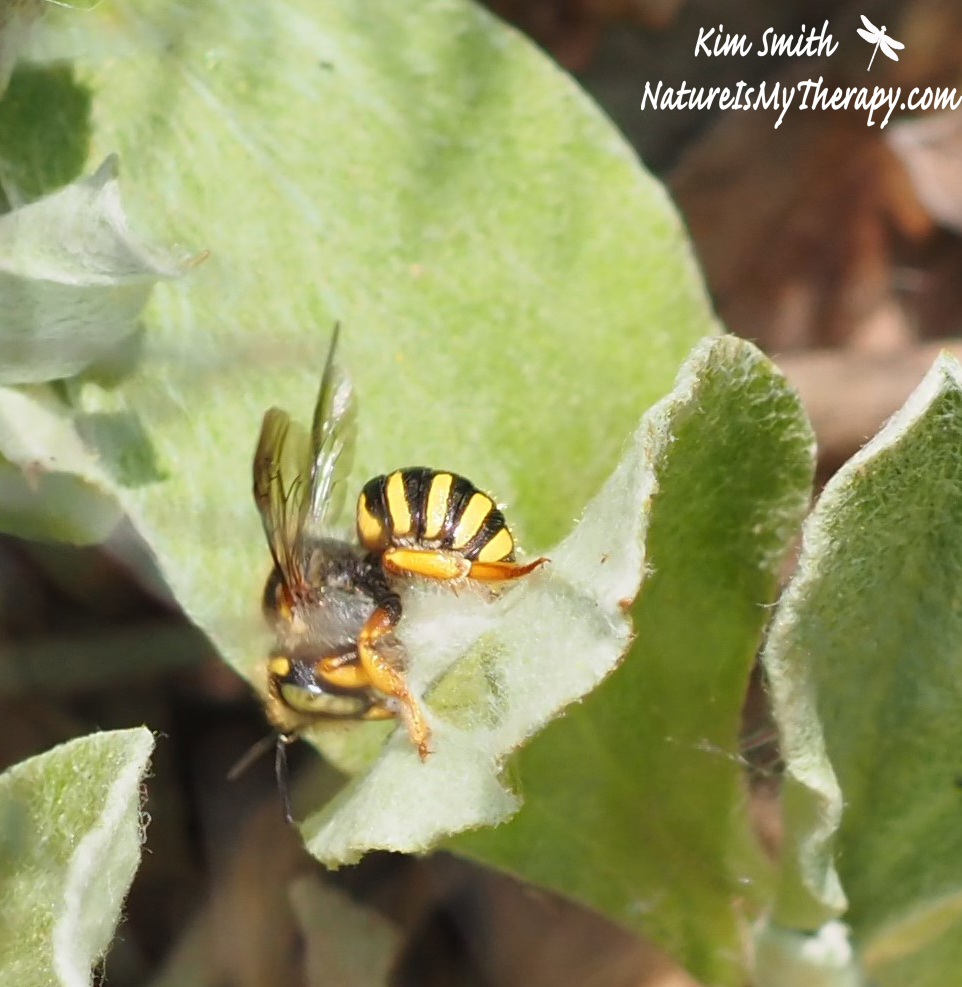

My brain instantly generated a list of theories about what the bee was doing. I worried about the butterfly eggs, but didn’t really think it would be eating those. Was it licking some sweet substance from the leaves? I was at a loss. Only when I looked at the pictures later did it all come together for me. First I uploaded the bee picture to iNaturalist and found that it was a type of carder bee, a solitary cavity-nesting bee, and most likely a non-native. Now knowing the type of bee, I continued to scroll through my photos to solve the mystery of its buzzy behavior. As I enlarged one of the photos, I suddenly saw what was going on. I almost face-palmed myself and said “Duh!” as I saw that the bee was carding the fuzzy fibers from the backs of the leaves! That’s what carder bees do, using their large mandibles, they scrape fibers from plants and use them to line a cushiony nest for their young. Take a close look at the photo above and you’ll see an area on the leaf where she’s scraped the fibers away, and a bundle of fiber tucked beneath her, ready to carry off to her nest. What a fun discovery that was!
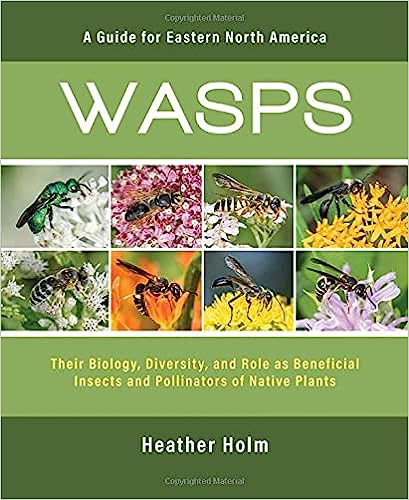
Next was the predator with prey encounter, always a dramatic moment. A small wasp had captured a spider on a Sullivant’s milkweed leaf. It had already flipped the spider over onto its back and was fiddling with it. The spider was obviously paralyzed, and was missing most of its legs by the time I happened upon this scene. I’m wondering if the wasp removed the legs to make it easier to handle and transport. Once again relying on iNaturalist, I found that the wasp was….drumroll please…a spider wasp. Almost another face-palm moment right there. Indoors later, I turned to my copy of Heather Holm’s wonderful book, A Guide for Eastern North America Wasps. It’s such a gorgeous photo-laden tome, and I’m always thrilled to have it in my personal library when I have a question about wasps.

The book says there are 300 species of Pompilidae spider wasps in North America, and they typically provision their ground nests with one spider, which their offspring will consume. They seem to be perfectly-designed spider hunters, with long legs that allow them more room to manipulate a spider under them, getting everything just right before flying off to the nest. She doesn’t eat spiders herself, she feeds on plant nectar or honeydew from aphids. I can’t figure out exactly which species this one is, but notice the beautiful metallic blue-black face and thorax. I think she’s stunning. I feel sorry for the spider, but…sometimes you’re the windshield, sometimes you’re the bug! (Thanks to Mark Knopfler for that classic line.) Everybody has to eat something/somebody, right?
When I was new to birdwatching, I was always sad when I saw a hawk or owl kill a songbird, as those were the birds that I felt closest to, having spent so much time getting to know them at my feeders. Over the years I learned not to think of it with that kind of emotion, as it’s the only way the predator birds can survive. They can’t fill up on leafy greens like we can; they have to eat birds or other animals. And if I claimed to care about birds, well, hawks and owls are birds too. And although I’m not as squeamish about watching insects eat each other, it’s the same principle. Some eat plants, but many of them eat other arthropods, and that’s just the way nature works.
And the last of my exciting finds on this day was that I’ve got ants farming aphids in my garden! Despite knowing about this phenomenon for years, I’d never observed it myself and was over the moon with glee as I studied the activity. Here’s a 30-second video so you can watch how the ants tend to the aphids.
I wish I hadn’t been alone when I found this because I had a desperate urge to show it to someone. From what I’ve read, some ants are known to secrete a substance from their feet that acts as a sedative or tranquilizer for the aphids. This serves to prevent the little critters from running away and ensures that the ant “farmers” retain access to their coveted supply of honeydew (aphid pee). I’m going to try to keep an eye on this farm and see if I can learn more. I found them on multiple branches of a single ninebark shrub, but I’ll be looking more closely at other plants to see if they’re more widespread than I realized.
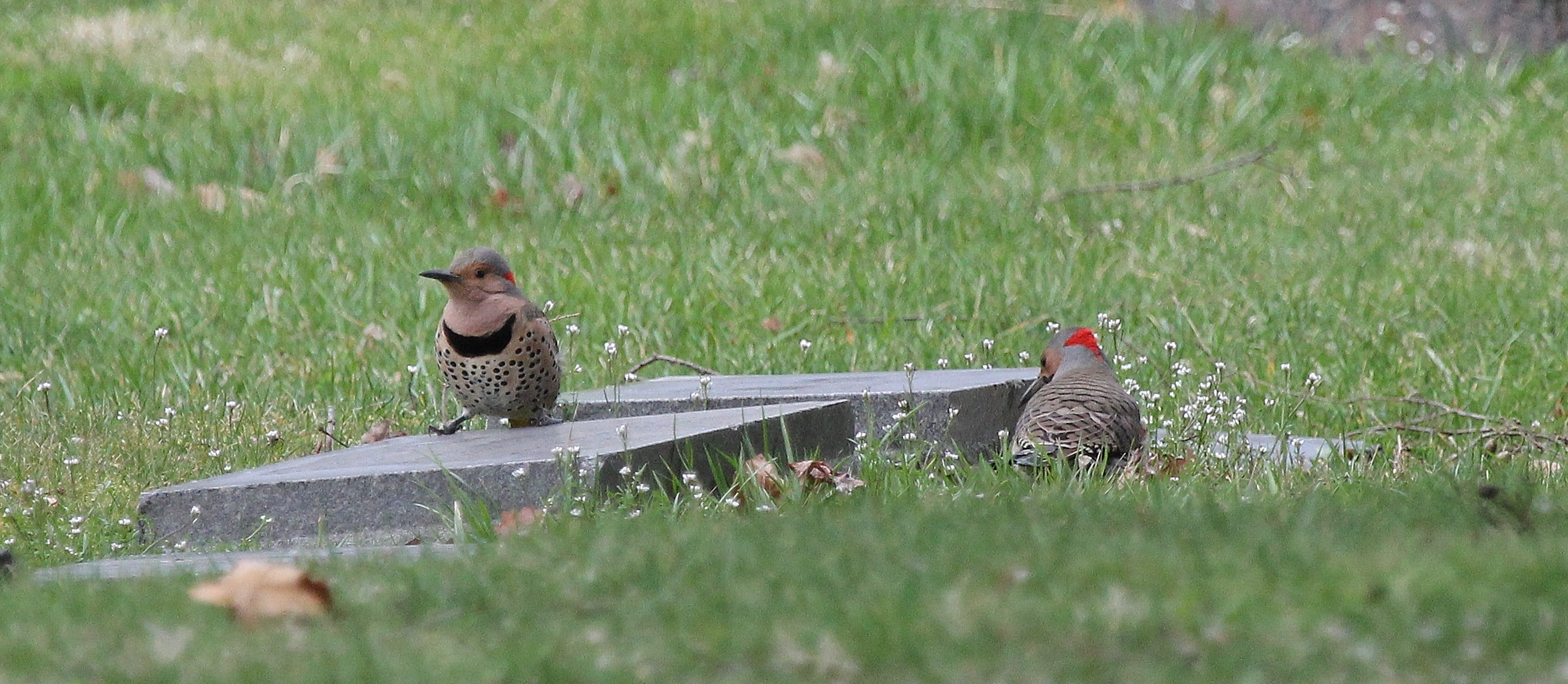
I rarely pay much attention to ants because they’re hard to photograph and to identify. But I’m reminded of the book, Tales from the Ant World, by famed entomologist E.O. Wilson. He spent decades fascinated by ants and traveled the globe to study them. I may have to pick that book up again as a refresher, but I remember how interesting it was to read stories from a man who loved these intelligent little beings so much. I don’t know about you, but reading stuff like this makes me even more appreciative of how our world functions. Ants are a vital thread in the fabric of the ecosystem that supports our own lives. They’re essential as decomposers, predators, and pollinators. And if you’ve ever watched a Northern Flicker feast on ants in the grass, you know that ants are also important as bird food. I’ve seen flickers hammer the ground to find ants, in the same way that other woodpeckers pound on trees. That might be what these two were doing in a local cemetery.
Now that I’m thinking of Edward Wilson again, I’d like to leave you with this two-minute video in which he talks about why he became a scientist. If it piques your interest, you can find more videos on YouTube and more of his books at your library. And there’s an exellent documentary about his life on PBS called Of Ants and Men. Maybe someone out there will be inspired to become a myrmecologist and continue the work of this remarkable man who won two Pulitzer prizes during his 92-year life. The rest of us will at least have more appreciation for the little things that run the world.*
Most people don’t give a hoot about anything smaller than a hummingbird.
E.O. Wilson, in the PBS documentary “Of Ants and Men, available online
**********************************
*E.O. Wilson referred to insects as the “little things that run the world,” because of their importance to the ecosystem.
 Nature is my Therapy
[…] Fascinating! Check out this article from Science Daily or more information, or enjoy reading about blogger Kim Smith’s aphids in her intriguing post here. […]
LikeLike
Hope I’m home i. time to check out our 9-bark for aphids and ant farmers. Would be cool to find. I’m fascinated by times when elements of nature (in this case the plant, ants and aphids) interact with each other. Always a reminder of how everything connects to each other.
LikeLiked by 1 person
Yes! This is why my garden has become such a fascinating part of my life — it shows me life on a level I’d never been aware of before.
LikeLiked by 1 person
Kim – You make nature fun. Love your posts.
LikeLiked by 1 person
Thanks, Bob, happy to know that!
LikeLike
Well now that was fascinating! I think I saw something about the ants and the aphids on a National Geographic show. I absolutely loved your video! And did I hear correctly that the ant scientist is blind in one eye? I don’t have a high-quality macro lens, and often I just use my zoom lens, but I am fasinated by bugs! And when I see them up close, especially on a photo I took, I’m blown away! Loved this post, thank you! Awesome photos!
LikeLiked by 1 person
Hi Lisa. Yes, Edward Wilson was blinded in one eye when he was about 7 years old, and he says that limitation guided him to study tiny things because he had to hold them up close to his face. (He passed away in 2021 at the age of 92.) I highly recommend the documentary if you can get access to it. I streamed it on PBS. Thanks for reading and commenting!
LikeLiked by 1 person
Thank you again Kim. That video of the ants farming the aphids was very interesting as well as the info you provided. There are not enough hours in my days to chase up all the interesting things in the world so I’m grateful when someone brings them to my attention. And yes, your garden is a farm!!
LikeLiked by 1 person
Oh I know, there’s never enough time for all the wonderful things, is there? Thanks Ardys!
LikeLike