
Our northwest Ohio spring has been very cold, windy, and rainy, so the bugs aren’t showing themselves much yet. Or maybe it’s just that I’m not spending time outside in that cold wind even if the bugs ARE there. Maybe that’s why I’ve turned my attention back to the birds lately. If you’re familiar with my path as a naturalist, you’ll remember that birds were my first love in the natural world. They fascinated me for several years before I fell in love with dragonflies and eventually all other insects. It feels good to spend time watching the birds for a bit without the distraction of the pretty bugs. I’m lucky to have several bird species allowing me some good peeks into their lives in my garden.
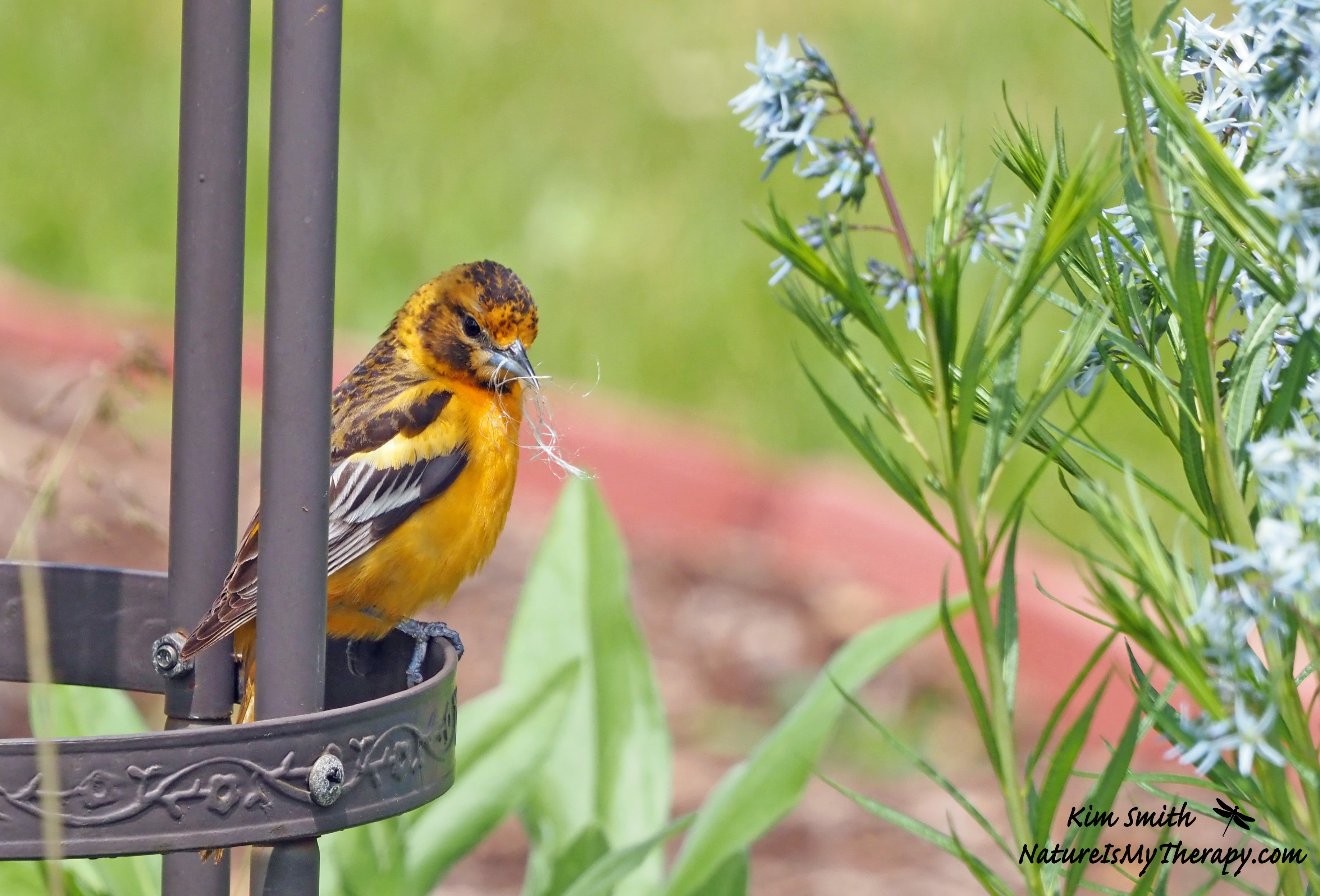
Baltimore orioles gather nesting materials in my garden every year but they usually build their hanging nests somewhere else. I hope one day they’ll choose to build in my garden, but for now I just enjoy watching them strip fibers from plants and fly away across the neighborhood to their hidden nest. I’ve seen both the male and female of this pair in the garden, and it seems the female is doing most of the gathering while the male supervises from utility wires above and hangs out at the pond.
Even when I can’t see them, the orioles’ beautiful clear song notes bring me smiles every day.
Another bird with a lovely song is the much more common American robin. I discovered a pair building a nest in my small chokecherry tree on May 1 and 2. I started taking photos and videos whenever I had a chance to sit and watch them.
After they finished the nest, they took a break for three days, and then the female started sitting on the nest on May 6 and, I presume, laying eggs. I think they lay one egg each day with a maximum of five. The female starts sitting on the nest all night after the last egg is laid.
I first saw them bringing food to the nest on the week leading up to May 20th. I could see them both standing on the rim and looking down inside of it, but couldn’t see the baby heads until May 24. Once the eggs hatched the parents started making frequent forays to gather food, returning every 4-5 minutes.
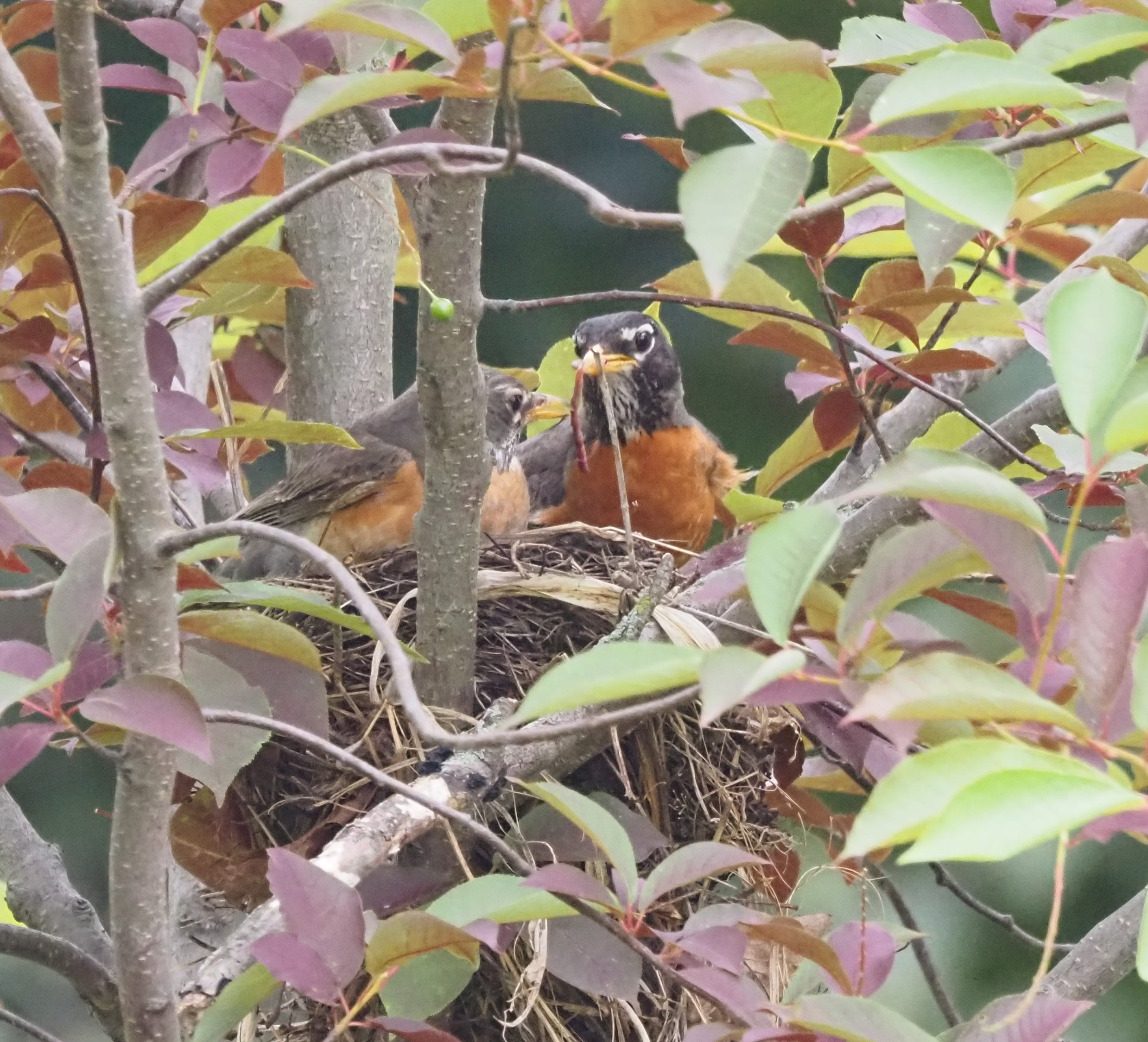
I’ve seen the male feeding the female on the nest, but she also takes breaks and leaves him in charge. One day I started to worry when she was gone for more than five minutes, but I guess she really needed a break! It’s interesting that when the male is in charge, he doesn’t settle down into the nest the way the female does but instead stands on the rim waiting for her to come back.
On May 24 I got my first good views of hatchling heads with their gaping mouths waiting to be fed. The short video below shows one of the heads popping up about 8 seconds in, on the left side. I can only confirm two heads so far, but there could be a few more in there. It only takes about two weeks for those tiny featherless birds to fledge from the nest, so they need a lot of food and they need it NOW. I’ve already seen a big difference in how high they can lift their little heads after just a few days of their protein-filled diet. I can’t wait to watch these babies take their first awkward flights. After they leave the nest they still can’t fly very well for a week or two, so they’re extremely vulnerable. (If they make it to that point I’ll be so nervous about the cat that shows up in my yard sometimes. I haven’t seen it for more than a week though so maybe the cat won’t be a problem.)
Note about the tree: If you’ve noticed the color of the leaves changing in these photos, that’s because this is a cultivar of our native chokecherry (Prunus virginiana) called ‘Canada Red.’ The leaves emerge a pretty green for the first few weeks, then they turn red for the rest of summer. If you want to grow natives to support insects, a cultivar that’s been bred for darker leaf color isn’t optimal because the chemicals in those leaves are sometimes not palatable to the insects who need to eat them. I bought this one before I knew of that drawback, and because I couldn’t find a straight native Prunus virginiana locally.
———————–
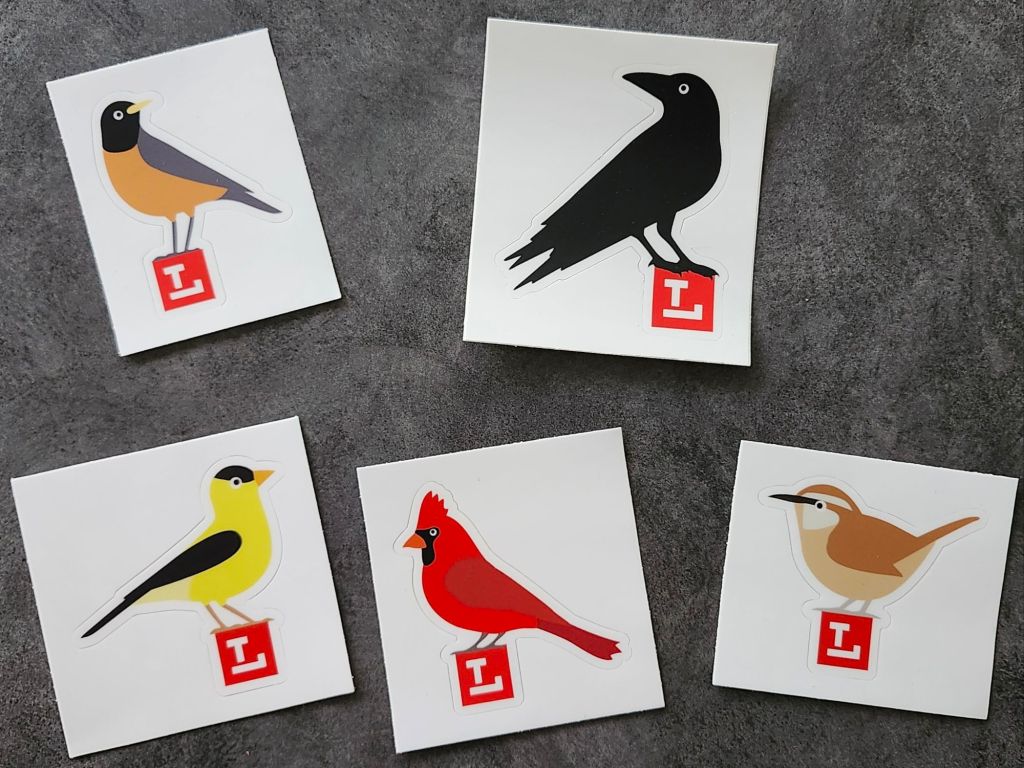
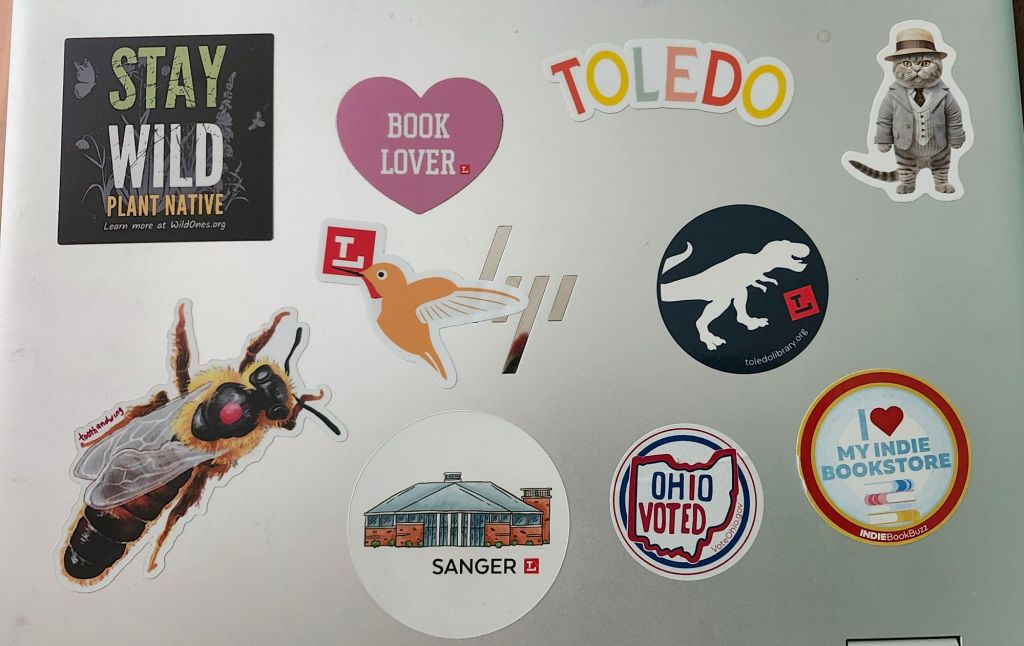
Even my local library has gotten bird fever this spring; they have this wonderful collection of bird stickers featuring our common birds. The day I was alerted to this collection by a friend, I went straight to the library to grab a set for myself. I’m a late adopter of trends in general, and for years I resisted the sticker craze. But finally I gave in and now my laptop and water bottle are adorned with stickers from places I’ve been and organizations I support. My birder brain kicked in when the librarian was handing me the stickers and calling them “this yellow one” instead of goldfinch, for example. I couldn’t resist telling her the names of the species. I know I could come off as a know-it-all when I do this, but I prefer to think I’m doing the birds a favor. People won’t care about protecting a species if they don’t even know its name; naming it builds a connection that might pique a person’s curiosity and lead them to want to learn more.
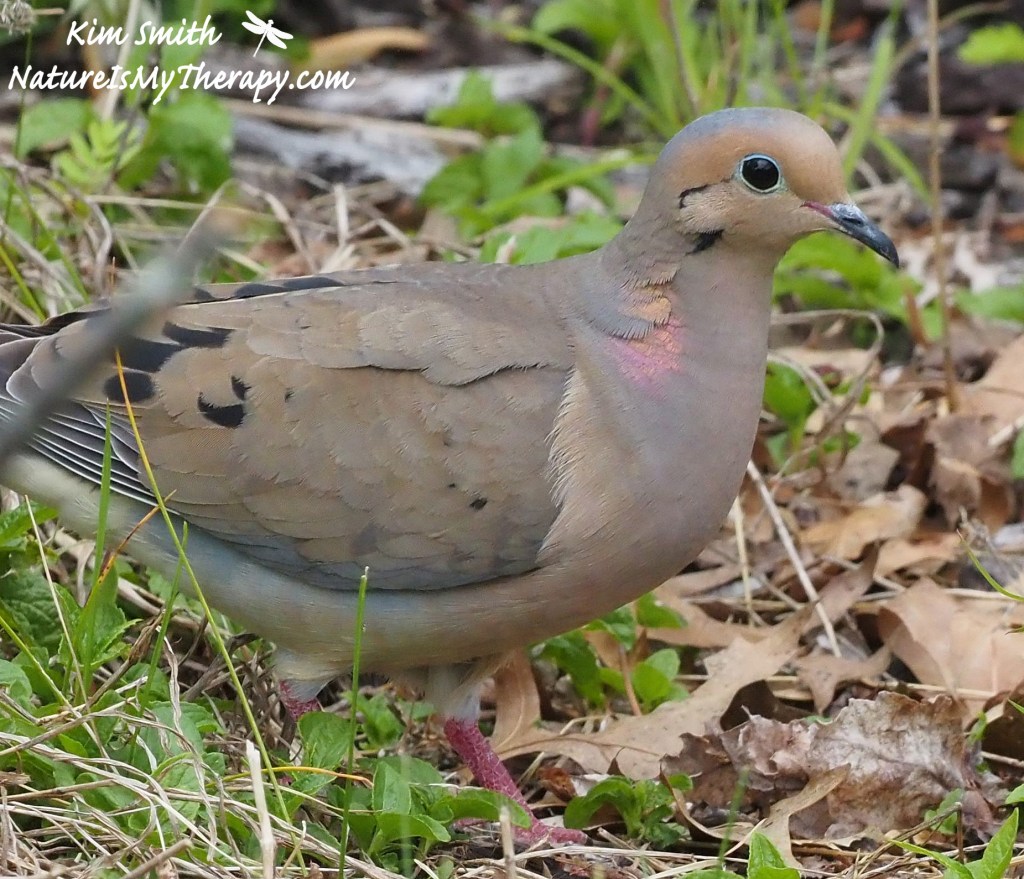
Finally, one more bird. In contrast to robins, mourning doves build some of the worst nests in the bird world. I’ve seen some that are little more than a few loosely draped sticks in the crotch of a tree. I wonder what their nesting failure rate is. But putting that aside, they are some of our most beautiful and overlooked native species. They’re fairly skittish and flush easily, so I’m lucky when I get a few nice shots of them before they take off like whistling rockets. Take a look at the pale blue ring of skin around the eyes. And the iridescent pink on the neck that only shows in certain light conditions. And their feathers look so fine that they always seem like they’re made of smooth brown clay. I watched a few of them exploring the pond a few days ago, and one of the males made some courting overtures toward a female but was rebuffed.
As I write this, we’re at the end of a warm sunny day with more on the way. I think my focus will shift back to bugs quite soon, but I’m so glad I took time to reconnect with the wonder of the bird world!


[…] of you may want closure on the story of the robin nest in my garden (see my previous post for part one). There’s some sadness but a happy ending. On May 29 I found the mother robin […]
LikeLike
Nice post! I agree on the cold spring. I was in Michigan’s U.P. the last week, and was thankful there were only a few blackflies, and the mosquitoes must have been mainly males out, as there were only minimal bothersome bites. Suspect “bad bug” season maybe has been delayed up there a week or so. However I’m confident “they’re coming up there” yet … “cringe”! Ron G.
LikeLiked by 1 person
I commented yesterday that i love your descriptions, in this case the Mourning Dove in particular. I must have done something wrong as my comment isn’t here. Hope it doesn’t show up later as a duplicate 🙂
LikeLike
I’m glad you tried again, Ginny, thanks! And I’m glad you liked this one. 😃
LikeLike
Thank you for your timely newsletter! Working at Toledo Library, I was so excited about the bird stickers!!! Linda Faye Lucas.
LikeLiked by 1 person
Hi Linda! Thanks for all you do to make our library system so wonderful!
LikeLike
The sound of birds stops the noise in my mind.-Carly Simon (at least attributed to her)
LikeLiked by 1 person
Howdy. I live in a suburb of Philadelphia. I hope I’m wrong, but there doesn’t seem to be as much birdsong here as before. It’s mid-morning right now, and I hear no birdsong at all. This indicates that the bird population in my area has dropped, maybe.
LikeLiked by 1 person
Neil, You’re right that bird populations have been dropping. But even with all of the resident birds living in my yard, I sometimes notice quiet periods too. Maybe they all take siestas together sometimes. 🥱🐦
LikeLiked by 1 person
Thanks for the birds Kim! I’m very partial to birds and am missing them from our previous home in Alice. The female Baltimore Oriole is lovely, her detail catches my artist’s eye. When we visited England years ago and I saw what they call (accurately) a Robin, I thought there must be some mistake! The English Robin is a dainty little thing compared to my knowledge of the American version which I learned is actually a Thrush. And your description of the Mourning Dove is so apt, they look like they have been painted with an airbrush. Hope your weather warms soon. xx
LikeLiked by 1 person
Yes, the American Robin is one of nine thrushes we have in Ohio. As you say, the European Robin is smaller and a member of the flycatcher family. I hope I get to see the European robins one day.
LikeLike
Great therapy
LikeLiked by 1 person