
What do you mean, you don’t talk to your six-legged garden friends? How odd. Oh wait, nevermind, I’m just emerging from a three-hour garden session immersed in insect world and it takes me time to get reoriented into ‘human world.’ I forgot that I’m the odd one, not you!
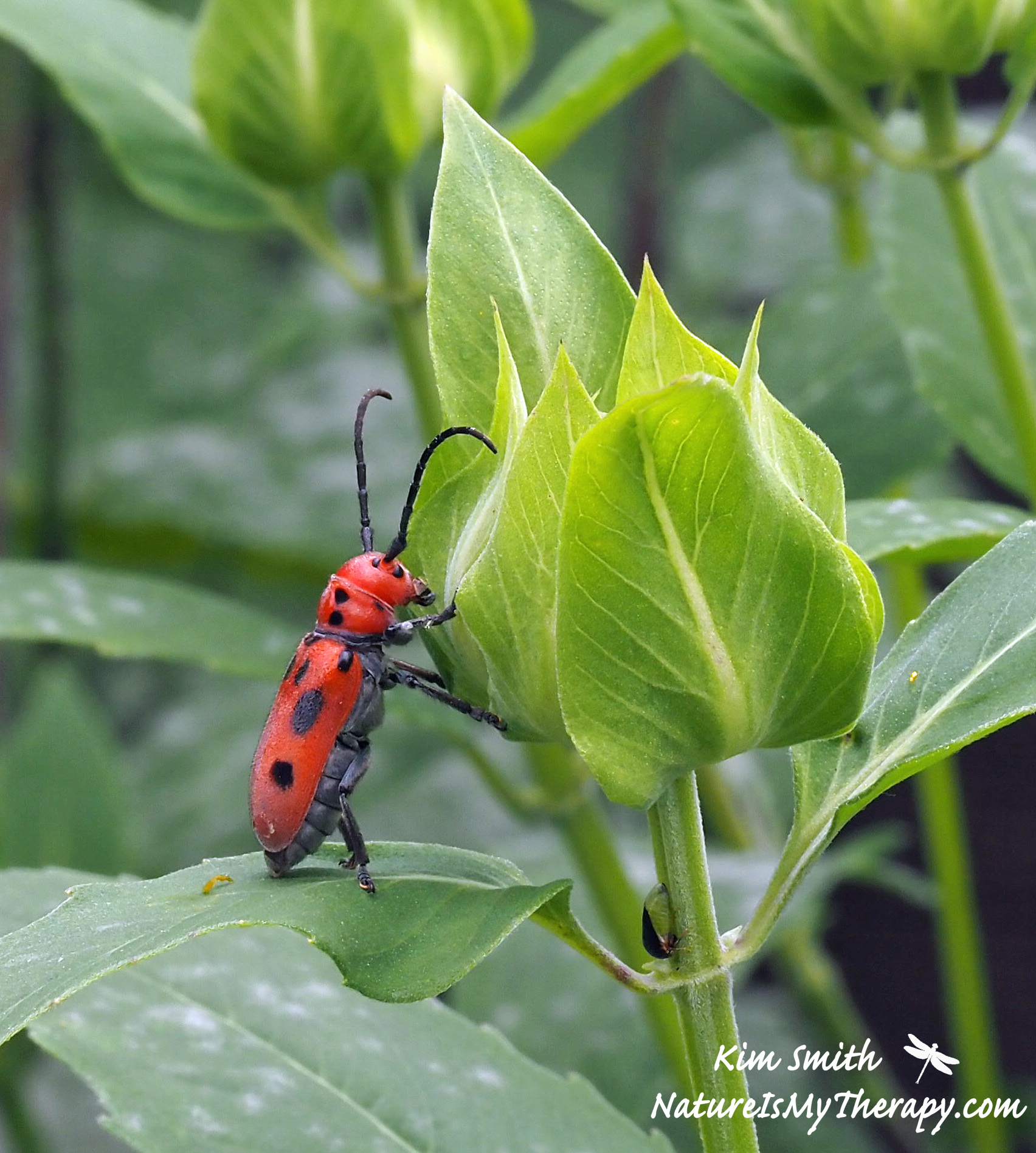
Something wonderful happened today: the red milkweed beetles finally showed up in my garden. I’ve been anxious about what seems to be a very late insect season this year. My native garden has a lull in blooms in June, but even so, there are usually many more insects active than I’ve found in the past several weeks. I only saw my first monarch butterfly yesterday, and I’ve been eager to find the milkweed beetles too. They’ve become my buddies, and every morning I make a beeline to the patch of Sullivant’s milkweed to say hello to the charismatic red and black long-horned beetles.
I knew that I’d seen them on June 21st last year, so when that date passed with no signs of them, I worried. After weeks of having my hopes dashed every day, I almost didn’t look for them today. But then I saw one peeking around the side of a leaf and my entire outlook on life improved instantly! Funny how we can let one little thing take on so much symbolic meaning in our lives. Or am I the only one who does that?
And the overall insect activity in the garden has finally picked up to what feels like a normal state of affairs. Today is the first day I’ve been able to spend hours out there without disappointment. I found lots and lots of fun little friends to whisper my secrets to.

So what do I say when I talk to my bugs? Well today I told this grapevine beetle “thank you!” just for showing up. You can’t go wrong by showing appreciation and acknowledging that they’re here. This one-inch long lunk normally feeds on grapevines but was on Virginia creeper in my garden. These also show up to my lights when I hang a moth sheet occasionally.
This chunky milkweed beetle was running back and forth on a single leaf as if he wasn’t sure where he should go. I whispered, “It’s okay, you’ll figure it out.” And he did.
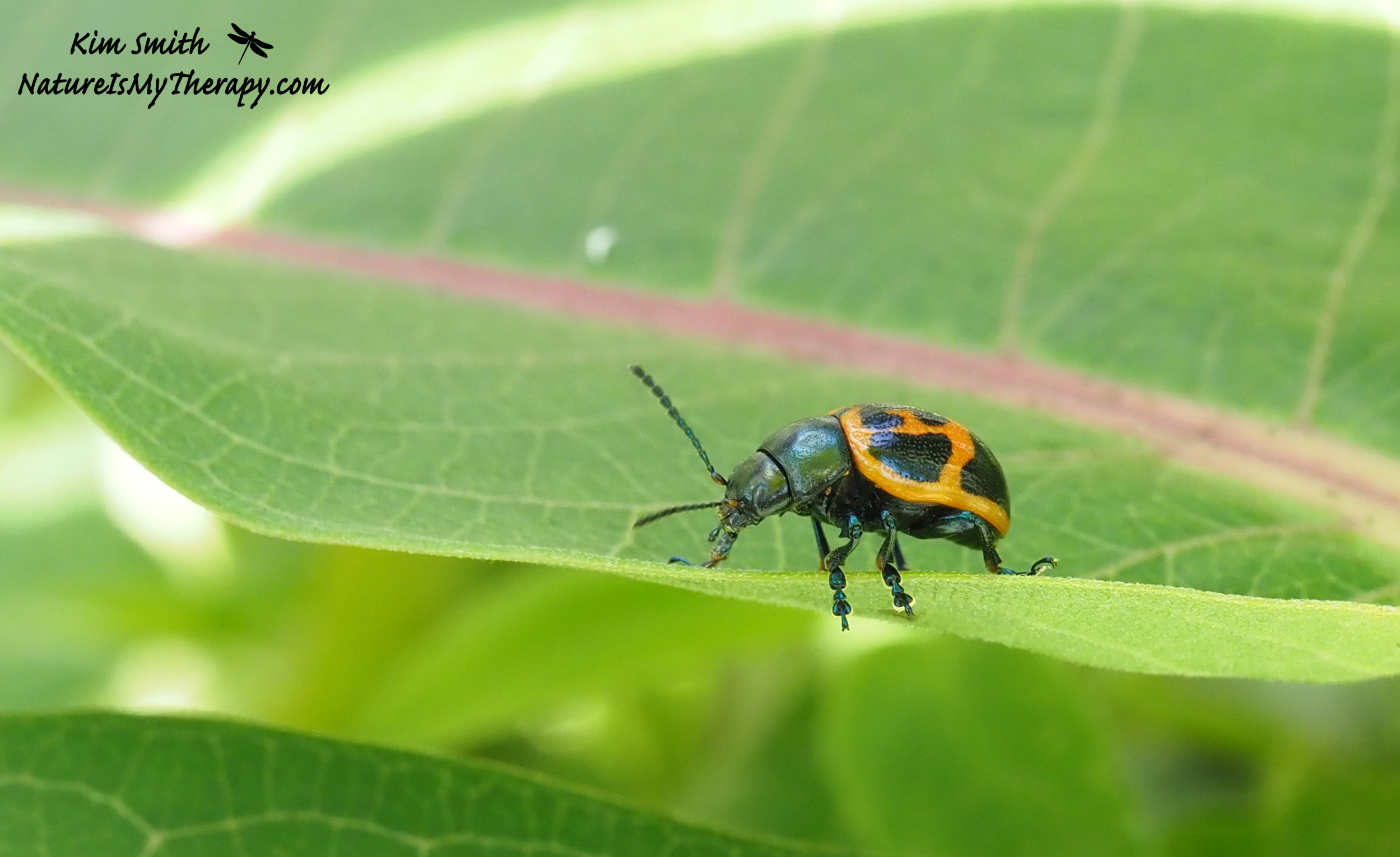
Like other insects that specialize on toxin-containing milkweeds, this swamp milkweed leaf beetle is wearing the aposematic colors that warn predators of a nasty tummy upset that awaits if they dare to eat it. Think of the orange and black monarch butterfly, and the orange and black large milkweed bug, and the red (and black) milkweed beetle shown at the top of this post. Only a young or color-blind animal is likely to taste these, and probably only one time. It’s a fascinating survival mechanism, isn’t it?
And speaking of warning colors, take a look at this fly who wants you to think he’s a big bad scary bee.

But his black and yellow colors don’t fool a close observer. Among other differences, bees have four wings, flies have two. This is a hover fly, totally harmless to humans, and a valuable pollinator and pest-control agent in the garden. Their larvae eat aphids, making them welcome in most gardens. I write about these hover flies (Syrphidae) often because so many people assume they’re sweat bees because they like to land on us and drink our sweat. Many times I’ve enjoyed watching them taking sustenance from my skin in this way, but I try to shoo them off of me if I’m wearing insect repellent that can hurt them. So remember, bees are bees, and flies are flies. Flies don’t sting. Please don’t slap or squish these cuties! (There definitely are some biting flies, though, and I will definitely slap/squish/dispatch those suckers given half a chance. A couple years ago I was bitten on my calf by a horse fly and had a 6-inch long swollen, itchy lump on my leg for a week. No thank you.)
So what do I say to a hover fly like this one? Nothing at all. I do them the favor of pretending I don’t see them trying to blend in with the color-coordinated black-eyed susans, and let them go about their business. They don’t need to know that I think they’re beautiful in their intricately-patterned bodies. Check out the abdomen pattern on this one:

I confess I don’t have a good suggestion for what to say to a wavy mucksucker, aka Crazy Eyes. Maybe just say his name a few times quickly and try not to laugh?

Wavy mucksuckers are hover flies, in the same family as the yellow and black ones above (Syrphidae), but a different genus. I’ll never forget the first time I saw these in my garden in 2021. Those eyes! Interestingly, those were on rattlesnake master just like this one was. I have two books about these flies and neither of them has information about their relationship with this plant.
I know most people would quickly say “Sayonara!” to this Japanese beetle, but I generally let them go about their business. Sure, they eat holes in some plants (especially the Virginia creeper), but my natives are tough and can easily survive their nibbling. So I just smile and say “Ohayo gozaimasu” (good morning) (おはよう) and “Genki desu ka?” (how are you?). When I lived in Tokyo I always got a kick out of the fact that their word for “good morning” sounds like the state I live in (Ohio).

I don’t want to give the impression that I never kill pests in my garden, but 99% of the time I let them be because they aren’t doing any lasting harm to the native plants. It’s better for my state of mind to let peace reign in my little world than to wage war on bugs and feel frustrated all the time. In fact, I wish I could maintain that “live and let live” attitude with regard to the non-native house sparrows who cause me so much grief. They were brought here from Europe in the mid-1800s to help control insects, but quickly spread across the continent and became a pest. House sparrows kill our native bluebirds and wrens and their babies, entering nest boxes and taking over. Unlike our native birds, house sparrows can have up to FOUR broods every year. And it’s not just their large numbers that upset me, but their large flocks are incredibly noisy, sometimes emitting repetitive chirps for hours at a time. And they’re very aggressive; it’s not unusual to see several of them trying to kill each other, pinning one down and pecking it to death. I don’t like seeing that sort of violence anywhere, and it’s especially upsetting at home. Oh well, let’s not dwell on that now.

This hummingbird clearwing moth has been here a couple times this week feasting on the monarda fistulosa (bee balm). It’s hard to speak to a hummingbird moth because every time I see one of these my breath catches for a moment. I usually get to see them a couple times each summer as soon as the monarda bursts into bloom. This one spent a few minutes visiting many of the light purple tubular blooms, sucking nectar from deep inside using its long proboscis. I always feel gratitude for their fairy-like visits. This little video will help you feel what it’s like to be in their presence:
Unfortunately, my conversations with these bugs are always one-sided. We’re not really communicating anything meaningful. But wouldn’t it be life-changing if we could actually talk to the insects and understand them? Imagine how fast our perspectives might shift regarding these tiny unappreciated beings who sustain all human life on this planet. What a wonderful world it could be. You may think I’m just weird (or lonely!), but I think this is a great way to embrace curiosity, foster empathy, and build a deeper connection with our environment. I’m all in, and I challenge each of you to find a bug to love. Thanks for reading!
“Ooh, it takes every kinda people [insects] to make what life’s about, yeah
my altered lyrics to “Every Kinda People” with apologies to songwriter Andy Fraser
Every kinda people [insects] to make the world go ’round”

___________________________
Important note about commenting: Several people have told me that they wanted to leave a comment but were deterred by the box asking for a login or password. It is NOT necessary to log in before leaving a comment. You don’t need a password at all. Just type your comment in the box, then enter your email address and name below the comment box. Nobody but Kim will see your email address. I really love to hear from you, so please consider leaving a note occasionally. Thanks!!
 Nature is my Therapy
Beautiful and VERY cool — thank you for sharing — such beautiful photography and awesome words! Cindy 🙂
LikeLiked by 1 person
Thanks Cindy!
LikeLiked by 1 person
[…] my previous post I showed you a short video of a hummingbird clearwing moth (Hemaris thysbe) feeding on monarda […]
LikeLike
Beautiful photos and message. I always thank the insects in my garden as I observe them keeping each other in check and enjoying the habitat I strive to provide. Thanks for the fun post.
LikeLiked by 1 person
Thanks, Cathy!
LikeLike
I like the red beetle and enjoyed your blog Kim.
LikeLiked by 1 person
Thanks, Mom. Those red beetles are the best!
LikeLiked by 1 person
Loved this post. You are the first person ever, I’m sure, to call a fly a cutie! You do have a big heart. I like birds with the exception of the pigeon mafia, and loved the sunbirds in our balcony. But I’ve talked to any. Maybe I will start now.
Thanks for sharing!
LikeLiked by 1 person
Thanks, Jaya. Have fun talking to the birds!
LikeLiked by 1 person
Kim-
I imagine that the bugs know how kind you are and sympathetic to thier problems because you take the time to give them native plants to feast on. I don’t know if they are sentient beings but if they were they would lke you.
daryl
LikeLike
Daryl, thanks for those kind words!
LikeLike
oooh, what a treat! 👏👏
LikeLiked by 1 person
FYI – Iâm replying to the email notification of your new post
Love this post! It made me laugh out loud because I was just talking to two different bugs in the AANA today. I was trying to take a picture of one very cool flying bug with long legs that had landed on my gloved hand when it proceeded to sting or bite me through my glove! So rude!
The second was a spotted lanternfly nymph. Second one Iâve seen in two days. Yesterday I found one on the fence post in the yard. Todayâs was on porcelain berry vine in the AANA and I told it to eat its fill. Theyâre pretty cool looking nymphs
LikeLike
Ha, I think my weirdness is rubbing off on you! I wonder what that bug was that bit you though. Too bad you didn’t get a picture of it.
LikeLike
I’m a kindred spirit Kim. Only I talk to birds. I ask how they are, remark about their numbers, invite them to have a nice breakfast as I put seed out for them…all the usual things. The hummingbird moth is mesmerising! Love it, have never seen or heard of one before. I love that you speak Japanese to the beetles too. They must appreciate someone not in a murderous rage 😉 Thanks so much for sharing your passion with us. xx
LikeLiked by 1 person
I’m so glad that you enjoy this type of thing as much as I do, Ardys. I just had another nice surprise as I was standing in the kitchen unpacking the veggies from my local farmer’s CSA, when my first hummingbird of the year buzzed the kitchen window as if to say hello!
LikeLike