That idiom definitely has a negative connotation, and I can only assume it evolved that way because people thought that plants aren’t pretty any longer after they’ve gone to seed. But I’m here today to make a case for the beauty of plants that have gone to seed.
A note before we dive in: Every time I want to write about the life cycle of a plant, I realize how much I simply don’t understand. I always do some research so that I’m hopefully not misleading anyone with what I write, but I’m usually left with more questions than answers. So keep that in mind. We’re all learning together here!
Having said that, when a plant has finished blooming, it produces seeds as part of the reproductive process. Those seeds are dispersed in a variety of ways depending on the plant; some seeds are moved by birds who eat the fruit (pooped out far from the original plant), some by ants (carried), some are tossed by the wind, others are just dropped by gravity or even “exploded” by force (more on that below).
Pussytoes gone to seed (Antennaria neglecta)
This is how my pussytoes look today, with a delicate, fuzzy halo of filaments. I see beauty here, don’t you? It seems to me those seeds will be wind-dispersed like those of dandelions. In my previous post I showed you a photo of the pussytoes in full bloom, with little white flowers on 14″ stems above their ground-covering leaves. As I was admiring them in this fuzzy stage today, another American lady butterfly arrived to lay eggs on the leaves. Remember that this is an important host plant for this particular butterfly species. The baby caterpillars will eat the leaves to survive until they can pupate into their adult stage. The first time this year that I saw eggs being laid here was in mid-April, but I never saw any caterpillars from that effort. And the same for another American lady’s eggs last month. So maybe the third time is the charm, and in a couple weeks I’ll find a wonderful batch of caterpillars feeding in those leaves.
American lady (Vanessa virginiensis) laying eggs on pussytoes
Notice how the butterfly is curling her abdomen to lay the egg on the underside of the leaf. That’s thought to be a protective measure so predators will be less likely to find them.
Another plant that’s moving through a new life stage in my garden is prairie smoke, which I also showed you last month when it was in its red firework phase. This is what it looks like now, and you’ll understand how it got another of its common names, Old Man’s Whiskers. It reminds me of those little troll dolls that were popular in the 1960s. I see beauty here too.
Prairie smoke (Geum triflorum), so dramatic!
Going to seed, indeed! Imagine if we could think of our own life stages with more appreciation for the physical changes we experience. Wrinkles and gray hair symbolize experience and wisdom. As plants age, they release their seeds and prepare for the next generation. Similarly, we can learn to let go, accept the transitory nature of our own lives, and make peace with the natural cycles of life. In the garden I always feel calmer about my own mortality and the idea that I’m just passing through. It reminds me to be present in the moment and feel gratitude that I’m here now to see these beautiful plants and bugs and learn the lessons they offer me.
Ninebark blooming a couple weeks ago (Physocarpus opulifolius)
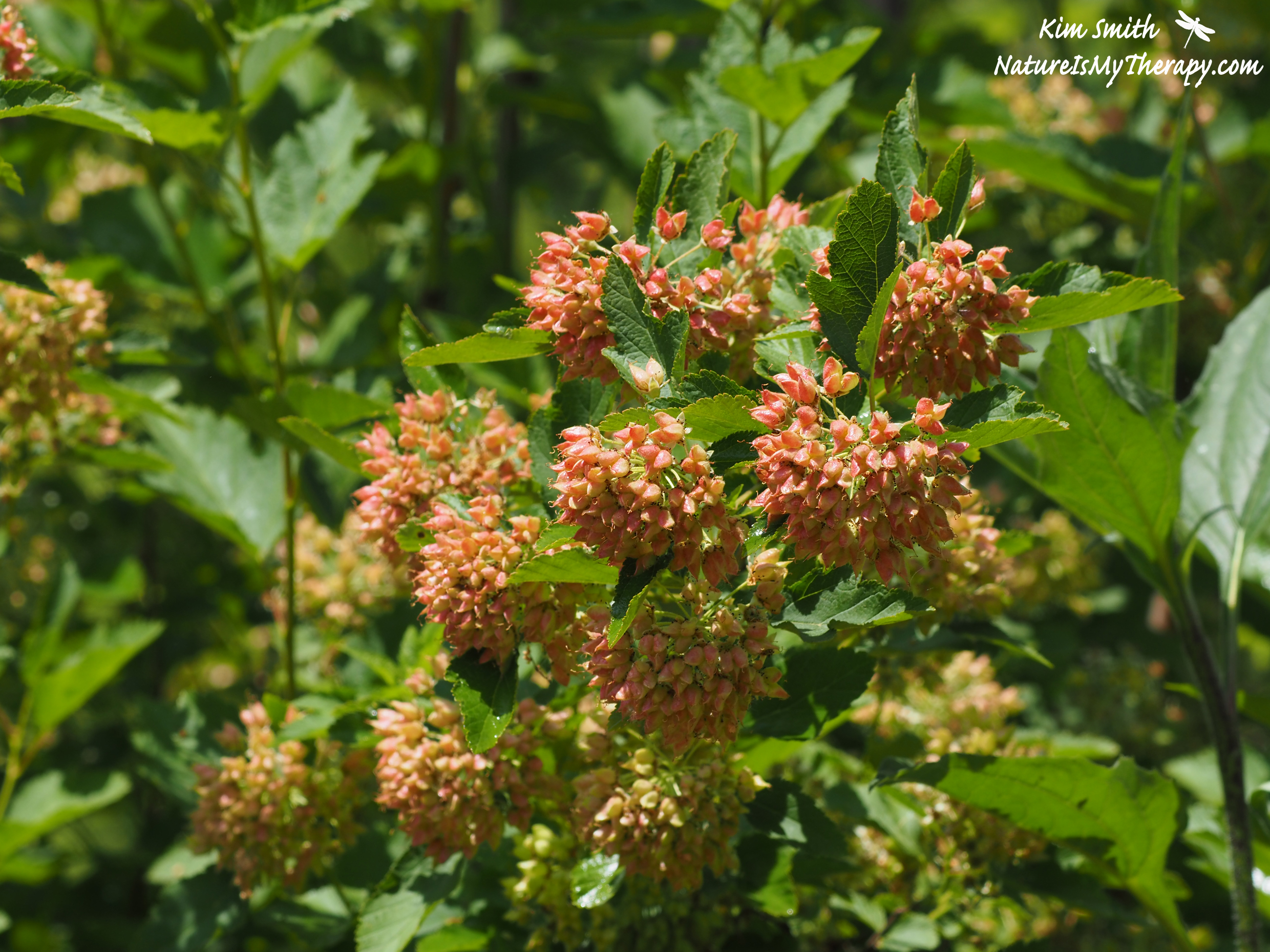
After only two weeks of beautiful cascading blooms, my three ninebark shrubs are moving into the next phase of their life cycle. Those hundreds of lovely upturned white flower clusters are now drooping bunches of peachy seed capsules. And far from being unattractive, I find these just as lovely as the flowers. And the seed capsules will linger through fall, feeding the birds as long as they last. Goldfinches seem to have a fondness for these in winter. (Note: Technically, these may be called fruits, but I’m not a botanist and am not confident of the terminology here.)
Ninebark (Physocarpus opulifolius), still attractive after flowering
I’ve got a couple plants that disperse their seeds by ballistochory, aka forceful ejection. As I understand it, the side of the seed pod that is facing the sun dries out faster than the other side, causing tension that eventually causes it to explode and eject the seeds. Partridge pea and wild geranium both use this method of spreading their reproductive material, and I can’t believe I’ve never tried to watch it happening. Must put that on a list of things to observe soon. To illustrate it for you, I found this very short video of Sir David Attenborough’s reaction to a seed explosion.
It sure looks like a fun way to spend some time in the garden, doesn’t it?
I’ve been impatient about how slowly the insect season seems to be starting this year, but maybe that’s pushed me to focus on some things I normally overlook. See, the garden is teaching me patience and resourcefulness! I’ve only found a few bees so far, which is because I don’t have many flowers blooming yet. But in a few weeks much more of my garden will burst into bloom and I’ll have many hours of fun watching the plentiful wasps, beetles, and other fascinating insects who live here with me. It’s getting so close I can feel it.
Common whitetail dragonfly (Plathemis lydia)
Today I was happy to have a dragonfly visitor, and was even able to get a photo. That’s rarely happened in my yard, as most dragons just zip through and don’t stay long enough for a high-quality visit. And right after the dragonfly, I snapped a photo of what I thought was some kind of ant on the side of my shed, only to find out that it’s a totally new species of long-horn beetle. New to me, not new to science, that is. And so my yard insect list grows by one!
I know it doesn’t look too exciting, but I’m always happy to find another new species here. This one doesn’t seem to have a common name, but it’s known as Euderces picipes. I need to do some research to learn more about him/her. Those white lines on the back of the wings are interesting details.
So…how are things going in YOUR garden right now? Can you find beauty in unusual places? Tell me in the comments!
Share this with your friends:
LikeLoading...
11 comments
When I started reading this entry, I was thinking of how I find our 9-bark sadly UNattractive after they bloom. So I was really surprised to see your photo of the really pretty “after blooms” of your nine bark. (Aside we’ve seen just loads of nine-bark up here on our TC vacation where we haven’t noticed them before. must be a good year for them.). My favorite seed heads on native plants is Golden Alexanders. Love those starbursts.
Isn’t it funny how someone else’s perspective can open your eyes to something you hadn’t appreciated before? That happens to me quite often when I read Cindy Crosby’s blog, Tuesdays in the Tallgrass. She finds beauty on the prairie in every season.
Beautiful and informative post. Most of your shares are unfamiliar to me but I enjoy reading about these unknown bits of nature. Thanks for sharing. Your heart is certainly in the right place. 👍
Some really nice thoughts here Kim. I did see beauty in all of these too! The American Lady butterfly is lovely. As always you inspire me to look closer.
Hi Kim. This is beautifully said. You’ve captured a basic reality of life, one that can be hard to accept: “In the garden I always feel calmer about my own mortality and the idea that I’m just passing through.”
Thank you, Kim, for another great post! And thank you for talking about nine-bark — thanks to you, I took the plunge and have three plants sitting in my driveway. Good inspiration! I’ve always loved this shrub, but never thought about it for the house. Yay! Beautiful photos, as always, and lovely words.




 Nature is my Therapy
When I started reading this entry, I was thinking of how I find our 9-bark sadly UNattractive after they bloom. So I was really surprised to see your photo of the really pretty “after blooms” of your nine bark. (Aside we’ve seen just loads of nine-bark up here on our TC vacation where we haven’t noticed them before. must be a good year for them.). My favorite seed heads on native plants is Golden Alexanders. Love those starbursts.
LikeLiked by 1 person
Isn’t it funny how someone else’s perspective can open your eyes to something you hadn’t appreciated before? That happens to me quite often when I read Cindy Crosby’s blog, Tuesdays in the Tallgrass. She finds beauty on the prairie in every season.
LikeLiked by 1 person
Enjoying!
LikeLiked by 1 person
Beautiful and informative post. Most of your shares are unfamiliar to me but I enjoy reading about these unknown bits of nature. Thanks for sharing. Your heart is certainly in the right place. 👍
LikeLiked by 1 person
Thanks, Jaya, I’m so glad you enjoy it!
LikeLiked by 1 person
Some really nice thoughts here Kim. I did see beauty in all of these too! The American Lady butterfly is lovely. As always you inspire me to look closer.
LikeLiked by 1 person
Hi Ardys. I’m glad you liked this one and saw the beauty too!
LikeLike
Hi Kim. This is beautifully said. You’ve captured a basic reality of life, one that can be hard to accept: “In the garden I always feel calmer about my own mortality and the idea that I’m just passing through.”
LikeLiked by 1 person
Thanks Neil, glad you liked it.
LikeLiked by 1 person
Thank you, Kim, for another great post! And thank you for talking about nine-bark — thanks to you, I took the plunge and have three plants sitting in my driveway. Good inspiration! I’ve always loved this shrub, but never thought about it for the house. Yay! Beautiful photos, as always, and lovely words.
LikeLiked by 1 person
Thanks, Cindy! And you were the first to make me take notice of plants in all stages of their lives, so thanks for that.
LikeLike