
Long-time readers of this blog may remember when I joined a CSA three years ago (here’s where I wrote about it). A CSA is a food co-op where you pay a membership fee that entitles you to weekly shares of local farm produce. It’s a great way to reduce your carbon footprint, eat healthier, and support local farmers so they can continue growing healthy food for your community. It’s a win-win. Except when it isn’t. The CSA I joined in 2011 fell apart in the middle of the summer due to the husband and wife farmer team getting divorced. My money wasn’t refunded and it left me disappointed and very wary of signing up for another one.
But time has a way of dulling that wariness, and after I talked to the owner of another CSA at this year’s Earth Day Festival I decided to give it a second try. I’m so glad I did. I picked up our first half-share from Harvest Michigan yesterday. Look what we got:
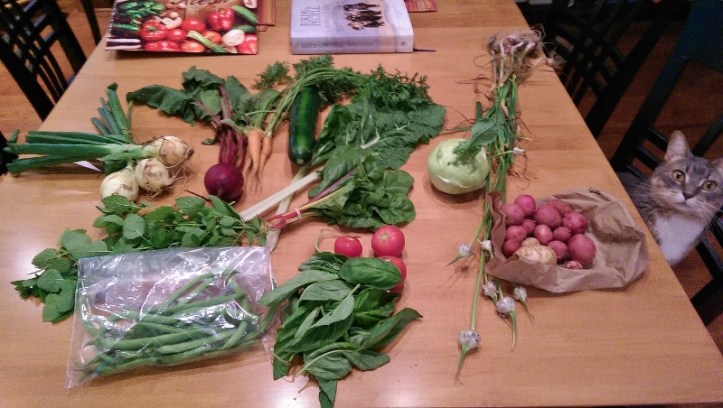
It makes me feel healthier just looking at it! There are onions, tomatoes, potatoes, cucumber, carrots, lettuce, chard, garlic scapes, beets, green beans, kohlrabi, basil, and mint. But here’s where I have to admit something embarrassing. I have no idea what to do with some of these things. And I don’t think I’m all that different from many Americans who have poor eating habits; I don’t eat a wide variety of fruits and vegetables on a regular basis. Potatoes, tomatoes, and green beans? Sure. But kohlrabi, chard, and garlic scapes? Not so much. I’m lazy when it comes to preparing meals, and far too often I’ll eat a packaged protein bar and call it a meal.
And what’s worse is that I’ve read enough about our corporate-controlled food industry to know better. And I’ve read enough about climate change to know how important our food choices are to the future of our species on this planet. And because of that, I get overwhelmed at the pressure of grocery shopping. To someone who doesn’t have to do the grocery shopping, it might seem ridiculous: You just go in the store, buy stuff, take it home, and eat it. Bing, bang, boom. Done.

But that’s not at all how it works, at least for me. Buying food is a hugely important responsibility. Our choices at the supermarket (and in restaurants) matter a great deal. If we continue to order veal in restaurants, calves will continue to be mistreated to produce that dish for us. (I do not eat veal.) If we continue to buy bananas from Latin America, they’ll continue to destroy forests to grow them for us. (Guilty on this one..I eat lots of bananas.) Unless we start buying more shade-grown coffee, big corporations will continue to destroy bird habitats to grow coffee in the sun (using lots of pesticides, by the way).
And there’s so much emotion wrapped up in food, isn’t there? We have lifelong habits to overcome, family traditions to change, and cravings to fight. I feel so guilty when I know certain foods have been shipped halfway around the world but buy them anyway because I want them and I’m in a rut. And what happens when I feel overburdened by guilt? I eat junk food. And the downward spiral begins. Eat. Feel guilty. Eat. Feel guilty…you know what I’m talking about. Imagine the difference if we can feel good about what we eat instead? 
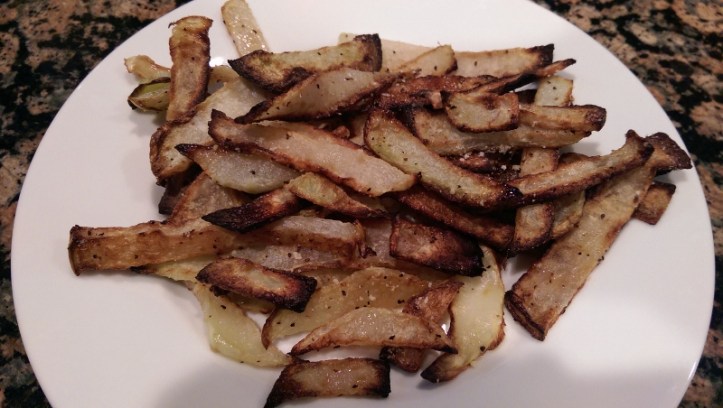
So I’m making yet another attempt to nudge my eating habits in the right direction, both for my own health and that of the planet. Two steps forward, one step back. But I guess the important thing is that I keep trying. I’m using my favorite recipe website to search by ingredients and will figure out ways to use all of these nutritious foods. (Except the beet…don’t think I can do that yet.) I noticed in my 2011 post that I’d written about eating kohlrabi and loving it. I can’t remember how I prepared it back then, but last night I cut it in thin slices and roasted it in olive oil with some salt and pepper and the tiniest bit of parmesan cheese. It was absolutely heavenly.
I think our eating habits in America have become far too detached from the actual sources of our food. If the CSA hadn’t told me I had a kohlrabi in my share, I would have had to do an online search to figure out what food it was. That’s embarrassing. Nobody should grow up in this country not knowing what a kohlrabi is. I could understand not knowing what a kumquat is, or a lychee. But kohlrabi is grown right here in the midwest, where I’ve lived for half a century! It’s possible these are my unique shortcomings, but I don’t think I’m alone in my disconnection from my food.

In recent years I’ve developed a bit of garden envy when I see people writing about their home gardens full of healthy produce. I would love to grow some of my own food too, but our heavily shaded yard with a big and voracious deer population is just not conducive to it. The only place I could possibly grow something is to put pots on the deck, but the deer even come onto the deck sometimes, so I haven’t tried. I have high hopes that one day I’ll be able to do it, but in the meantime I’m so thankful for our local farmers. They’re not only nourishing my body, but they’re teaching me something I should have learned a long time ago. Food for thought, indeed.
 Nature is my Therapy
Beet fan club member here!! Ha ha! Before adhering to the Paleo (Caveman) diet, I did not take full advantage of vegetables or fruits in my diet, let alone availability. Now I must seek sources other than the local groceries because I am picky about additives, preservatives, and any toxins in food. It is difficult to discover local like-minded folks who have the same ideas I do about food. I have had to be very selective and research my options. I learned the hard way that the local farmer’s markets did not insure that a product was free of pesticides, or that the produce was grown or harvested safely. There is so much “trust” that goes along with purchasing “clean” foods. It’s overwhelming sometimes!
LikeLike
Yes, you do have to trust the people growing and delivering your food. And that’s really hard to do because they so often let us down. As you know all too well, it takes an enormous amount of time and effort to do the research. I think that’s why most people give up. I go through cycles where I’ll give up and just eat what I want, and other times where I’m much more selective and make a good effort to find safer foods. What always gets me is this: Think about 300 million people in this country each having to go through this process on their own, and all the effort that could be saved if the government could/would enact better food regulations and enforce them. Ah, I know, that’s a dream that’s unlikely to come true, in my lifetime at least.
LikeLike
Kim there is nothing better than fresh produce and in the summer months my husband gets busy with potatoes, spinach, corn, pumpkin, shallots, tomatoes and bok choy. We love it fresh from the garden. The food here looks fresh I wish everybody could experience a veggie patch.
LikeLike
Kim, I really enjoyed learning about CSA’s. I had considered them briefly in the past, but didn’t know anyone who belonged to one, or even much about them. I think you’ve inspired me to check into them further. I LOVE fresh produce, and like you, I am all for supporting the local growers. I am from the Midwest as well, where much of this is plentiful; why have I waited so long? Enjoyed your post very much!!
LikeLike
Thanks for the comment, Jules, and I’m glad I inspired you to consider a CSA too! Check out these search results for Nebraska on LocalHarvest.org: http://www.localharvest.org/search.jsp?map=1&lat=41.260654&lon=-95.93434&scale=9&ty=6&nm=CSA&zip=68102 Good luck!
LikeLike
It looks like a very nice selection with just enough of the reliables and new flavors to keep it interesting.
LikeLike
Beets are fabulous! And remember to steam the leaves. I enjoy them just as much and sometimes more than the root!
LikeLike
There must be a “beet fan club” out there…who knew so many people loved them? Too funny.
LikeLike
This is awesome! I am so glad that there are so many people realizing the huge impact that our eating habits have. in a few weeks, I am starting what I call the “August 2014 Local Eating Challenge.” I am hoping to leverage some of this “local” momentum to help people make some real and meaningful changes in their lives. Keep up the good work!
LikeLike
Thanks, Dadosaurus Rex! (What a great name.) I hope your Local Eating Challenge is a huge success, and I hope to explore your blog a bit more very soon.
LikeLike
I love this one, Kim! We had talked about signing up with a CSA here, but kind of let it go. You may have inspired us to get moving. Also, I agree with Gail’s recommendation about beets on a salad with feta and pine nuts, although I usually cook them iand add pickling spices, sugar, and red-wine vinegar.
LikeLike
It looks like I’m going to have to be a big girl and try to eat my beets! I hope you can find a good CSA near you.
LikeLike
It sounds like you are going to really enjoy your new CSA, Kim. Garlic scapes are one of my favourite vegetables. Due to not having my garden boxes in until this spring I wasn’t able to plant garlic bulbs last fall, which meant no scapes to harvest this summer. They are delicious in stir fries, salads, casseroles, stews, and well, just about anything really. What site do you use where you put in your ingredients and it tells you what meals you can make?
LikeLike
Kristie, I use Allrecipes.com. I set up an account so I can save recipes to my “recipe box,” but have since discovered that I can just as easily save them to Evernote (it clips web pages to a file that I can easily tag and retrieve later).
I have to admit, I couldn’t figure out which part of the garlic scape to use. Do you use the little garlic bulb on top, or the green stems, or the root bulb at the bottom? I tasted parts of each one and couldn’t figure it out…. I read somewhere that they should be curled or they’re too tough to use. My stems were not curled, and they were kind of woody. Advice?
LikeLike
If your stems weren’t curled and are woody they were harvested way too late. You will just have to throw them out, and you might want to let the person who raised them know they should have been harvested much earlier. The point of cutting the curling scape off the garlic plant is to keep it from flowering. If it forms a flower at the top the energy of the plant is being directed to the flower instead of the garlic bulb forming under the ground. For next time you have scapes, the part you eat is the green, curled stems.
LikeLike
Thanks for the tips. I’m going to send a note to the CSA about that.
LikeLike
Thanks, Gail, I’ll keep that in mind if I decide to give it a try!
LikeLike
Beets are also wonderful roasted and eaten hot or tossed with a light Vinagrette and eaten on a bed of spinach as a salad. Sprinkle some feta and toasted pine nuts on top if you wish.
LikeLike